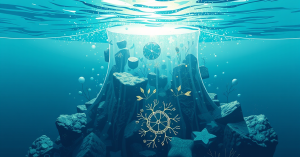
Nine thousand meters down, in total darkness and crushing pressure, there’s rock. And on that rock, according to research published in Science, there’s life nobody expected to find there. Using the manned submersible Fendouzhe, a team surveyed hard substrates in the Kermadec and Mariana trenches, at depths ranging from 9,000 to 10,898 meters, and turned up 32 species spanning six protist and metazoan phyla. Most are millimeter-sized. Most are new to science.
Here’s the part that upends prior thinking: the filamentous organisms dominating these communities turned out to be heterotrophic foraminiferans, not chemolithoautotrophic microbes as earlier hypotheses suggested. That’s a meaningful correction, since it changes how these hadal ecosystems are getting their carbon. And this wasn’t a one-trench fluke, either, large-scale seafloor imaging and sampling indicate that similar protist-dominated sessile communities are thriving across seven hadal regions around Oceania.
What does this mean for how we picture the deep ocean? The authors argue these findings unveil biodiversity at depths previously written off as barren, and point to widespread carbon hotspots scattered through global hadal trenches, ones that had gone unrecognized until now. Not bad for rocks nobody thought to sample carefully.